

State Attorney General Coalitions After Meta — Four Forks, Correction Authority and the Lessons for the Next Defendant
Where the Meta coalition game turned, what platform and agentic artificial intelligence (AI) counsel can still change before a bridge state files, and how to read the board that plays it
Meta · Snap · OpenAI · State Attorneys General · Federal Trade Commission · Colorado · Tennessee · California · Kentucky · New Jersey · New Mexico · Rhode Island · Arizona
Companion: MindCast War Gaming Vision: Visual Guide — How to Read a MindCast Board in Seconds explains how to read the boards that carry the paper's forks and forecasts. The paper extends Multi-State Enforcement Against AI and Platform Companies, which sets out the Meta agreement's terms.
Full publication: https://www.mindcast-ai.com/p/state-ag-coalitions-after-meta
One Filing Set the Size of the Meta Coalition
On October 24, 2023, a Democratic attorney general in Colorado and a Republican attorney general in Tennessee led one complaint against Meta. Colorado's attorney general said he filed because he could not reach a resolution with the company. Nearly three years later, Meta's Form 10-Q described payments of up to approximately $18.59 billion across 52 attorneys general. The paper finds that the 2023 filing, not the 2021 leak, decided how large the coalition grew.
Central finding. Once a cross-party office files, no defendant can stop a multistate coalition from growing, because breadth tracks the cost of joining. Before that filing, a resolution with the investigation leads can still cap breadth. Depth stays within the defendant's reach at every stage, and the paper tests whether depth traces to one governance fact: who inside the company approves corrections to measured harms.
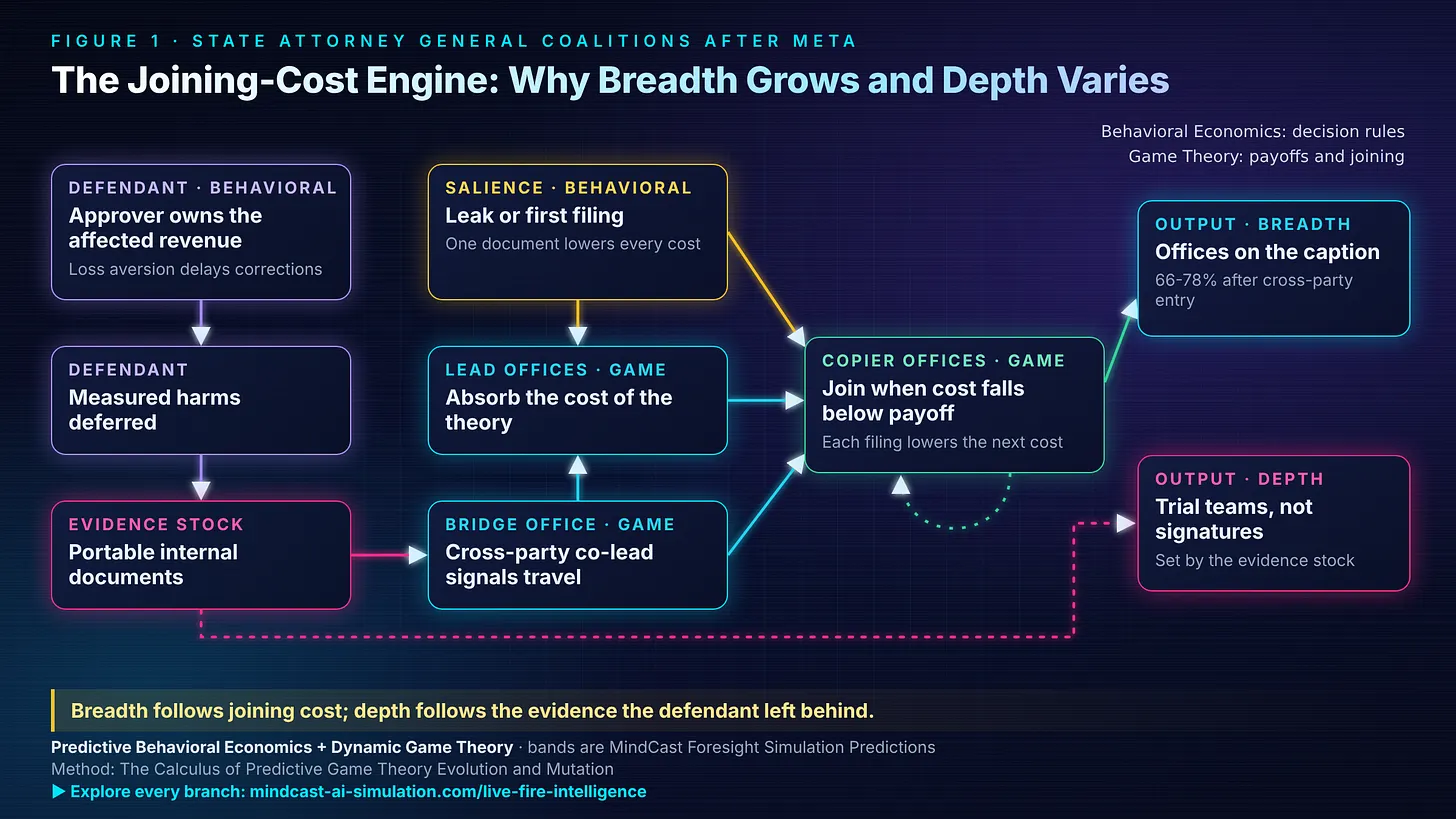
Joining cost sets breadth. Each filing lowers the cost for the next office, because an office that copies a complaint pays only to adapt it to local law. The 2021 leak made joining nearly costless for every office at once, so a conduct offer that year had little to buy (I2, 65% (50-78%)).
The bridged filing marks the point where breadth stops responding to the defendant. A cross-party co-lead tells every other office that the theory travels. The paper reads the October 2023 filing as the largest change in the coalition's breadth (I1, 70% (55-80%)).
Correction authority sets depth. Reported internal documents indicate that Meta's correction approver owned the revenue a correction would forgo. H-1 tests whether that placement deepens commitment, and only a disclosed change in who approves corrections would establish the mechanism.
The Ninth Circuit's August 10, 2026 holding closed Meta's last early exit. The court held that Section 230 provides a defense to liability rather than immunity from suit, eight days before trial. Holding into trial won the peer conditions that tie Meta's payments to rival adoption, and a pre-trial deal would likely have lacked them (I3, 60% (45-72%)).
What the Full Paper Adds
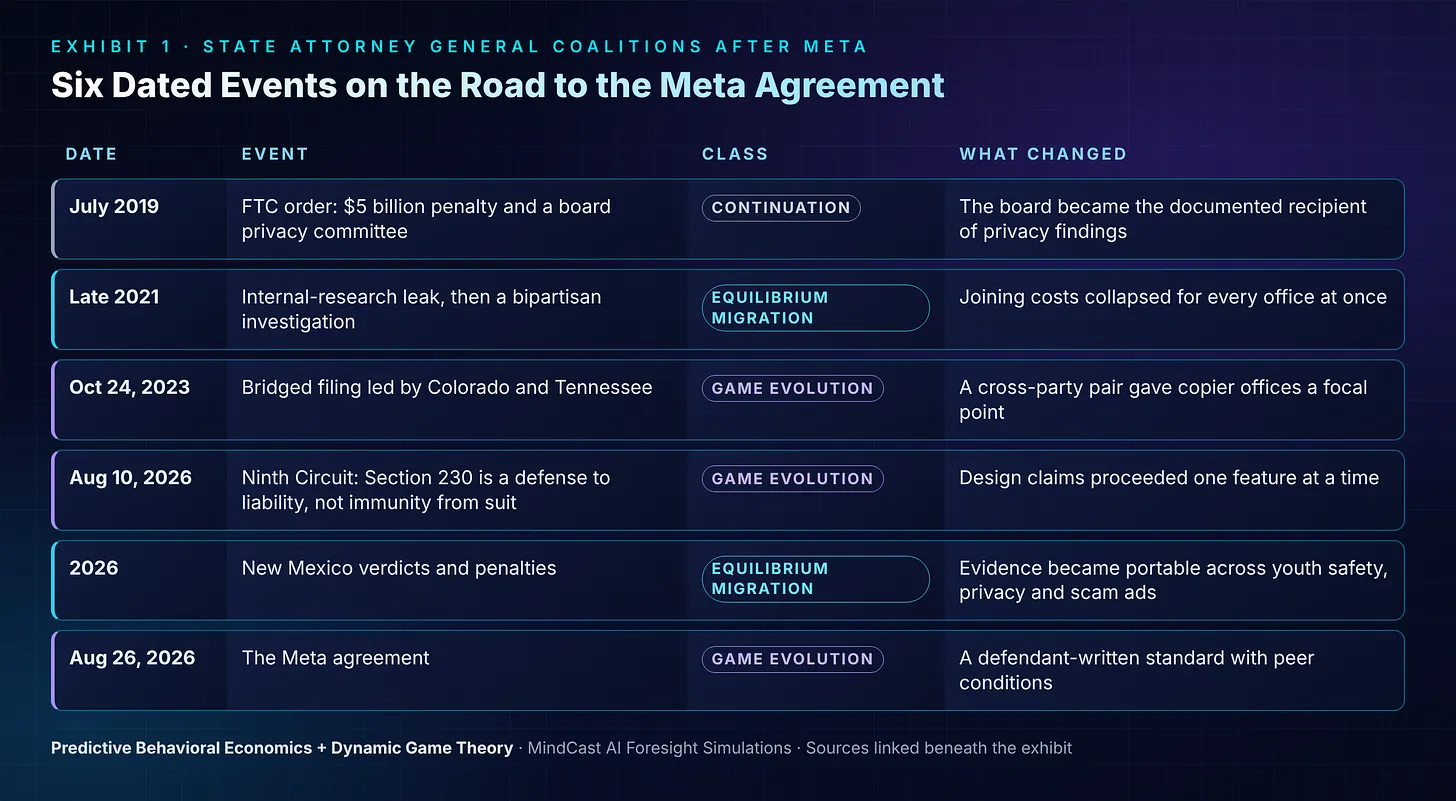
The full paper carries eight MindCast Foresight Simulation Predictions: five event predictions resolving by December 31, 2027 and three interpretive reads on the past forks. It sets out six dated events and four forks with evidence cutoffs running from July 24, 2019 to August 17, 2026. Three rival explanations compete with stated falsifiers, and three exhibits and five numbered figures map each stakeholder's moves by time gate. Primary filings anchor the history, from the 2019 Federal Trade Commission order to the Ninth Circuit opinion and Meta's Form 10-Q.
Read the four forks, the falsifiers and the moves by stakeholder in the full publication.
MindCast Foresight Simulation Predictions
The paper's eight forecasts come from a short-horizon Foresight Simulation through 2027. P marks a Primary and S a Secondary Simulation Prediction, and I marks an interpretive read.
P1. A state other than Rhode Island sues Meta over scam advertising by December 31, 2027: 74% (61-85%).
P2. Fifteen or more states have filed attorney general actions against OpenAI by December 31, 2027: 70% (55-82%).
P3. Providence Superior Court denies Meta's motion to dismiss Rhode Island's scam-ad complaint in whole or in part by December 31, 2027: 68% (55-79%).
S1. Meta announces it will block rather than surcharge advertisers flagged as likely scammers by December 31, 2027: 36% (24-49%).
S2. OpenAI resolves with 10 or more state attorneys general by December 31, 2027: 24% (14-37%).
I1. The October 2023 bridged filing marked the largest change in the Meta coalition's breadth: 70% (55-80%).
Each forecast carries a deadline, a falsifier and a named verification source. The full paper lists all eight, including the two further reads on the 2021 and 2026 forks.
How to Read the Board
MindCast War Gaming Vision: Visual Guide — How to Read a MindCast Board in Seconds teaches the grammar every MindCast board uses, and the Meta forks read directly in that grammar. The guide works one coffee shop example, so its odds are teaching values rounded to tens rather than MindCast Foresight Simulation Predictions.
Seats and survival. Each party holds a seat strip: a filled circle holds its position, a half circle adapts and an open circle loses. Read the strip before the bands, because survival decides whether a band matters to that seat.
Forks and lanes. A diamond marks a mover and a dated event that forks the game, and each card to its right is one successor state with one band. A lane marks a second mover on its own clock. Rhode Island's motion ruling reads as a diamond fork, while the OpenAI filings run as a separate lane.
[Insert With Media Tool: Board 2. Card color encodes the change, and the change sets the instruction · Visual Guide, Section II]
Card color. Gray means the same game with moved positions, so the forecast carries forward. Cyan means the game evolved, so the forecast needs revalidation. The bridged filing and the Meta agreement were both cyan events, and red marks a mutation that expires the forecast and rebuilds the board.
Direction and horizon. Converging branches return to known states, so a reader can commit. Diverging branches open new paths, so the reader should buy information at the first fork. The eyebrow line names the horizon: the paper's event forecasts run short horizon, while its coalition-propagation hypotheses run long horizon and stay unbanded until enough coalitions resolve.
Practice the grammar on the States vs. OpenAI Interactive War Gaming board.
What Each Stakeholder Decides
Each callout names the decision at stake and the move that lowers exposure before the next fork. The order runs from the seat closest to the decision.
⚖ General Counsels. The first reasoned ruling becomes the basis every copier files on, and a cross-party co-lead closes the window for a narrow resolution. Risk mitigation: map likely bridge offices and open talks with investigation leads while breadth can still be capped.
💼 AI Strategy at Agentic Firms. Correction authority is the one lever no coalition can reach. Risk mitigation: route correction approval for measured harms through a body with no revenue target, and document the move.
📈 Issuers Preparing an Offering. OpenAI filed confidentially for its offering days before the 42-state investigation became public. Risk mitigation: place correction authority before the registration statement, which stops new deferrals from accumulating ahead of the offering.
🛡 Risk Mitigation Specialists. Exposure arrives through breadth first and commitment second, and defense costs reach carriers while penalties mostly stay with the defendant. Risk mitigation: separate penalty exposure from defense-cost exposure in each renewal.
📊 Investors. Approver placement is visible before any coalition forms, and late joiners follow public recovery allocation at 76-88%. Risk mitigation: size exposure by users times states rather than by the states that sued.
🏛 Policymakers. State coalitions now set binding design terms faster than federal rulemaking or legislation. Risk mitigation: a legislature that wants a voice in AI conduct standards acts before the next coalition agreement writes them.
Conclusion
The October 2023 filing by a Democratic and a Republican office set the size of the coalition Meta faced for the next three years. Meta's later choices changed depth and cost, not breadth. OpenAI now faces eight coordinated suits that pair Arizona's Democratic office with seven Republican offices, the cross-party signal the Meta history warns about.
Working With MindCast
MindCast AI applies Predictive Behavioral Economics + Dynamic Game Theory through MindCast AI Proprietary Cognitive Digital Twin Foresight Simulations (MP CDT FS) across Complex Litigation and Innovation. Behavioral Economics supplies the decision rules, and Game Theory supplies the payoff structure. The analysis supports containment-window assessments for defendants, coalition-exposure sizing for issuers and carriers, and war gaming sessions in which a client's team plays its own moves. Contact [email protected] or visit www.mindcast-ai-simulation.com.
Related Works
MCAI Lex Vision: State Attorney General Coalitions After Meta · the publication
MindCast War Gaming Vision: Visual Guide — How to Read a MindCast Board in Seconds · the companion guide
The Calculus of Predictive Game Theory Evolution and Mutation · the foundational method
Predictive Game Theory Simulations Through War Gaming · the war gaming method
Multi-State Enforcement Against AI and Platform Companies · the Meta agreement's terms
How State Attorney General Coalitions Form, Grow, and Hold · the joining-cost model
State Attorney General Coalitions — How Lead States Set the Template and Why Other States Copy the Complaint· the copied complaint
Meta and Bank of America Foresight-to-Duty Conversion · approver placement
States vs. OpenAI Interactive War Gaming · All MindCast war gaming
Share Your High-Stakes Matter
Contact Us
Office location
Bellevue, Washington, 98006Send us an email
[email protected]