

Commerce’s Rented GPU Rule: The Cutoff Date Decides Its Reach, and Lutnick’s Tenure Decides What It Exempts
An approved rule sits unpublished at Commerce while Chinese labs rent Blackwell-class chips in Southeast Asia
Commerce Department · Bureau of Industry and Security · The President · Treasury · Senate Banking Committee · Congress · Nvidia · Megaspeed · Southeast Asian Data Center Operators and Lenders · Chinese AI Labs · Malaysia · Singapore · Thailand · Indonesia · Brazil · Norway · South Africa
Papers 1 and 2 of the MindCast AI Export Control Series update, extending the remote-access forecasts in Tencent, Oracle, and the Remote-Access Gap and The Runtime Export Problem.
Paper 1 · Commerce’s Rented GPU Ban Would Exempt Chips Already Delivered, and the Cutoff Date Decides Its Reach: https://www.mindcast-ai.com/p/regulating-rented-gpus
Paper 2 · Lutnick and the Commerce Department Likely Miss January 10 on the Rented GPU Rule, and His Tenure Shapes What It Exempts More Than When It Publishes: https://www.mindcast-ai.com/p/chip-export-rules-delay-lutnick
MindCast also updated our interactive war gaming module based on developments. https://magazine.mindcast-ai.com/geopolitical-ai-chip-export-interactive-war-game
Washington bans sales of Nvidia’s Blackwell-class chips to Chinese companies but lets Chinese labs rent the same chips abroad. A former Commerce official says an interagency-approved rule to close that gap was ready in July 2025. On November 13, Treasury Secretary Scott Bessent said four agencies had wanted action for months, “but Commerce has the pen.”
Two companion papers answer the two questions the gap raises. Paper 1 forecasts what the rule will exempt when it publishes and where Chinese demand moves next. Paper 2 forecasts when the rule publishes and how much the official who signs it changes the outcome.
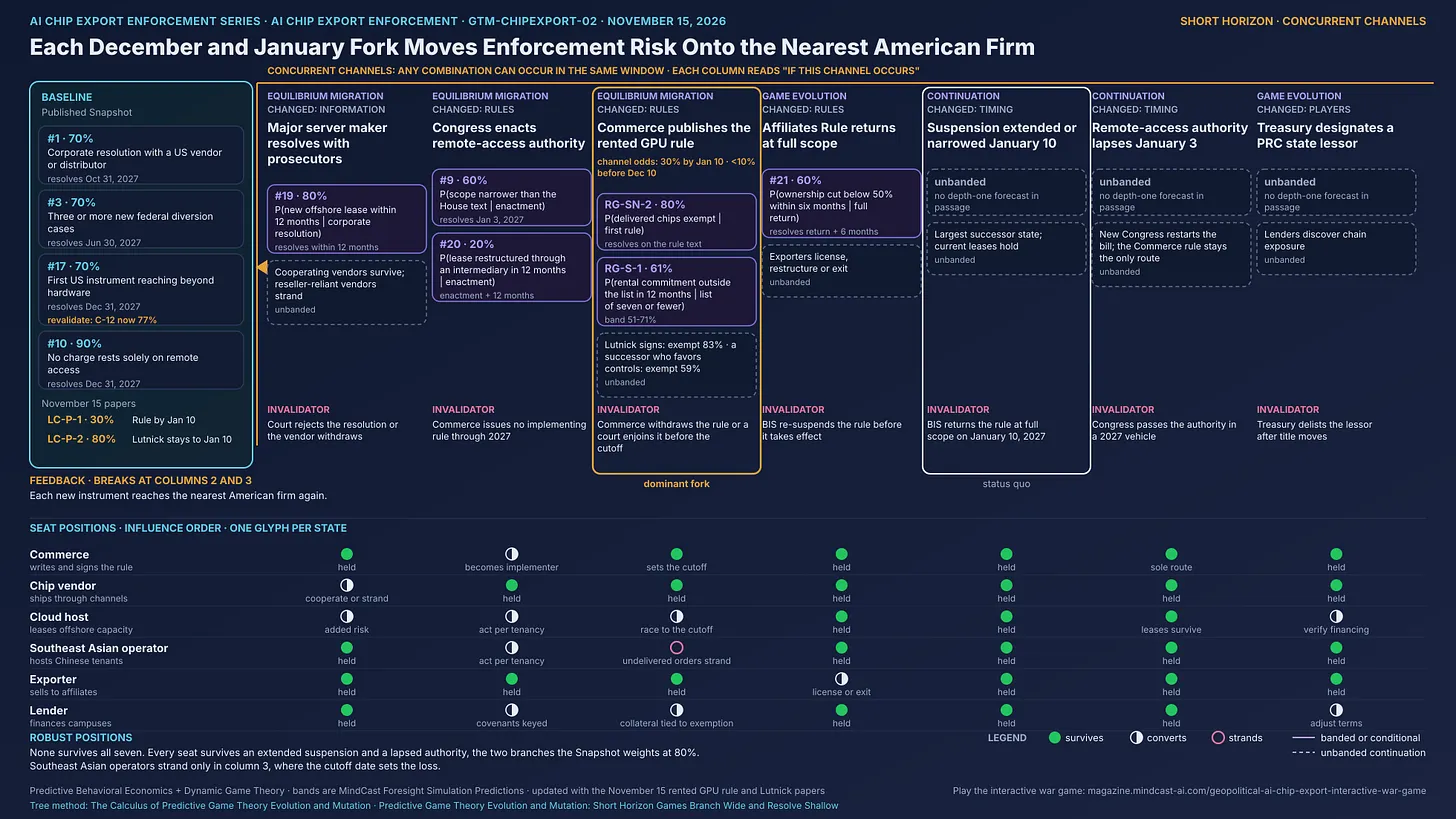
Central finding: the rule will likely miss January 10, 2027, and when it arrives it will most likely exempt every chip already delivered. Commerce Secretary Howard Lutnick’s tenure moves that exemption more than it moves the rule’s timing.
Both papers come from MindCast AI Proprietary Cognitive Digital Twin Foresight Simulations (MP CDT FS), which apply Behavioral Economics + Dynamic Predictive Game Theory to the actors around the rule. Game theory supplies the payoff structure, and behavioral economics supplies the decision rules each actor follows.
How the Rule Works and Why It Stalls
Five mechanisms connect the two papers, and each one names who gains or loses.
The shipment line comes first. Export law regulates where chips ship, so the reported draft licenses only chips delivered after a cutoff. Every chip delivered before that date keeps serving Chinese tenants, and operators now race to take delivery first.
Lutnick holds the pen. He weighs losses to licensed Nvidia sales and to trade with Beijing more heavily than gains in control, and loss aversion explains 16 months of requests for options rather than decisions. The December 10 Senate Banking hearing raises the cost of waiting but leaves little time, so a rule before testimony stands at 5%.
Tenure moves design more than timing. A departure lifts the odds of a rule by January 10 to 35%, against 24% if Lutnick stays. The exemption for delivered chips falls from 83% under Lutnick to 68% under a successor, and to 59% under a successor who favors controls.
The country list relocates demand rather than denying it. The draft names seven countries, four of them in Southeast Asia. Chinese labs answer a short list by renting in unlisted hosts, which makes the list itself the next fork.
Lenders carry the exposure Washington can reach. About half of new Malaysian project financings have stalled, and collateral value now rests on an exemption that a statute or a successor could revoke. The result is a rule whose timing turns on one official and whose reach turns on one date.
What the Full Papers Add
The two papers carry 26 MindCast Foresight Simulation Predictions between them. Each has a range, a type, a falsifier and a verification source.
Paper 1 maps four states that would end the exemption, four candidate rule designs and eight Cognitive Digital Twins, with the arithmetic that blends both signers. Paper 2 maps seven reachable states from the baseline of delay and tests six candidate causes of the stall, each with its own falsifier. Together they carry 13 risk entries with owners and deadlines, two monitoring protocols and six figures.
Read the full analysis, with every state tree, risk entry and falsifier: Paper 1: https://www.mindcast-ai.com/p/regulating-rented-gpus Paper 2: https://www.mindcast-ai.com/p/chip-export-rules-delay-lutnick
MindCast Foresight Simulation Predictions
Seven Foresight Simulation Predictions carry the argument across both papers.
Commerce publishes a remote-access rule by January 10, 2027: 26% (12-43%)
Lutnick remains Commerce Secretary through January 10, 2027: 79% (71-86%)
A rule by January 10 if Lutnick’s departure is announced by then: 35% (22-49%), against 24% (10-41%) if he stays
The first rule exempts chips already delivered, whoever signs it: 80% (70-80%)
The exemption holds at 83% (79-86%) if Lutnick signs and 68% (64-73%) if a successor signs
A China-parented rental commitment is reported outside the seven-country list within 12 months of the cutoff: 61% (51-71%)
A listed operator or lender cites the rule in a securities filing within 120 days of publication: 81% (72-90%)
Each Foresight Simulation Prediction carries a deadline, a falsifier, an activation rule and a named verification source. The full set of 26 ranges from 5% to 92%. Earlier MindCast work assigned 83% to no sanctions on six named Chinese labs before September 24, and 80% to a notice on the Affiliates Rule by November 10; both resolved as called.
What Each Stakeholder Should Do
Eight audiences face decisions before the rule publishes, ordered here by proximity to that decision.
Bureau of Industry and Security drafters. The cutoff date decides how much capacity stays open. Setting the cutoff at publication ends the rush without widening the country list.
White House and Treasury. A missed January 10 leaves the rental route open through the truce date. Setting a publication date for the approved draft and preparing intermediary sanctions that do not depend on Commerce close that gap.
Senate Banking Committee members. The December 10 hearing is the last dated lever before the defense bill closes. Requesting the July 2025 draft and its sign-off file before testimony turns the hearing from the stall to the rule’s terms.
Defense bill conferees. Statutory language left out by January 3 moves to the next Congress. Writing a tenant-identity duty and an early cutoff into conference text is the only route that replaces the gatekeeper.
Export-control counsel. A rule could arrive with little notice over the holidays. Drafting tenant clauses and client alerts for both license and notice designs before December keeps year-end contract reviews ahead of publication.
Southeast Asian operators. Chinese revenue survives on delivered chips and fails on undelivered orders. Confirming export dates for contracted hardware now protects the tenant contracts that depend on them.
Lenders to Southeast Asian data centers. Collateral holds value only while delivered chips stay exempt. Stress-testing collateral with and without the exemption before year-end credit reviews sizes the exposure a successor or statute could create.
Equity investors in regional operators. Lutnick’s tenure conditions the value of delivered capacity. Building a departure case for each holding before December 10 sizes the revenue a successor’s rule could reach.
Every audience shares two dates: December 10 for the hearing and the cutoff for the rule.
Conclusion
Washington still lets Chinese labs rent the chips it bans them from buying, and the rule to stop it has sat approved at Commerce since July 2025. The two papers explain the gap in two lines: one official holds the pen, and the pen draws its line at delivery. Delay will likely outlast January 10, and the next holder of the pen decides how much delivered capacity stays open to Chinese labs.
Working With MindCast
MindCast AI is a predictive institutional cybernetics firm in Bellevue, Washington, delivering Foresight Simulations and war gaming built on Behavioral Economics + Dynamic Predictive Game Theory. The analysis supports remote-access posture mapping, offshore compute contract review, capital posture review and compute placement strategy. A commissioned Snapshot with a delivery-schedule overlay or hearing scenarios arrives within five to seven business days. Contact [email protected] or visit www.mindcast-ai-simulation.com.
Related Works
Commerce’s Rented GPU Ban Would Exempt Chips Already Delivered, and the Cutoff Date Decides Its Reach: https://www.mindcast-ai.com/p/regulating-rented-gpus
Lutnick and the Commerce Department Likely Miss January 10 on the Rented GPU Rule, and His Tenure Shapes What It Exempts More Than When It Publishes: https://www.mindcast-ai.com/p/chip-export-rules-delay-lutnick
Geopolitical AI Chip Export Interactive War Gaming: https://magazine.mindcast-ai.com/geopolitical-ai-chip-export-interactive-war-game
The Runtime Export Problem: Anthropic’s 151 Million-Exchange Distillation Record, Advisory AA26-251A, and the Question Commerce Cannot Yet Answer: https://www.mindcast-ai.com/p/runtime-export
Tencent, Oracle, and the Remote-Access Gap in US AI Chip Export Controls: https://www.mindcast-ai.com/p/tencent-oracle-remote-ai-access
Enforcement Incidence and Capability Denial in Artificial Intelligence Export Controls: https://www.mindcast-ai.com/p/bis-ai-enforcement
AI Chip Export Enforcement Shifts Risk Onto US Firms as China Demand Moves to Domestic Chips, Rented Compute and State Financing: https://www.mindcast-ai.com/p/q42026-ai-chip-geopolitical-enforcement-snapshot
AI Chip Export Enforcement War Game Shows When Verification Protects US Firms and When It Arrives Too Late: https://www.mindcast-ai.com/p/q42026-ai-chip-geopolitical-enforcement-war-game-companion
The US Bureau of Industry and Security Affiliates Rule Turns Export Controls Into Bargaining Instruments: https://www.mindcast-ai.com/p/bis-ai-affiliate-rule
Import Controls, Export Controls and the US–China AI Infrastructure Contest: https://www.mindcast-ai.com/p/global-ai-race-import-export
Foresight Analysis in Illegal GPU Export Pathways (2025–2030): https://www.mindcast-ai.com/p/dojchinachips
The Runtime Global Data Market: When Stolen AI Interactions Become a Strategic Technology Supply Chain: https://www.mindcast-ai.com/p/runtime-data-market
Cross-Border AI Compute: Access Rules, Clean Power and Local Approval Decide Which Operators Win: https://www.mindcast-ai.com/p/cross-border-ai-compute
Share Your High-Stakes Matter
Contact Us
Office location
Bellevue, Washington, 98006Send us an email
[email protected]