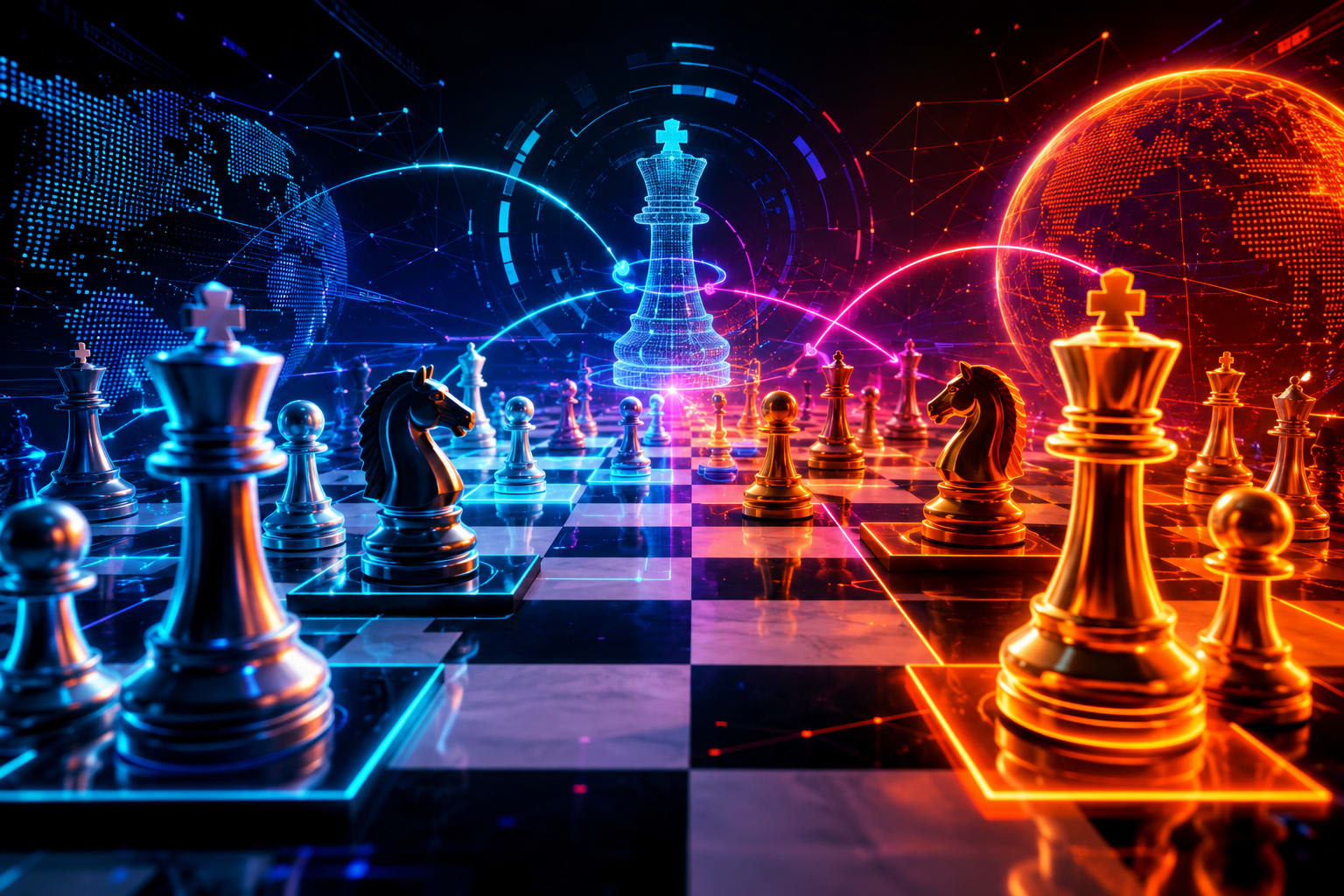
From the courtroom and the classroom to the simulation.
Our practice grew out of work at the crossroads of law and behavioral economics, advanced further through artificial intelligence innovation. That combination — legal reasoning, economic theory, and machine learning — is what allows us to model decisions the way they actually unfold, not the way textbooks assume they should.
We are engineers of foresight. Where traditional consulting offers opinions, we build simulations, encode the incentives of every actor involved, and let the model show us the range of realistic outcomes.
What Differentiates Us
Our dynamic predictive game theory, paired with our proprietary cognitive digital twin behavioral economics foresight simulations, allows us to move beyond static forecasting. Where competitors offer a single prediction, we deliver a full decision tree — the optimal path, and every risk path worth watching.
This is the same discipline that produced a more accurate Super Bowl LX forecast than Madden NFL and Sportsbook Review, and the research that Stanford Law School chose to republish.
Predictive Intelligence
MindCast AI operates out of Bellevue, WA, applying dynamic predictive game theory and behavioral economics foresight simulations to complex litigation, innovation economics, and geopolitical risk. Our team works with legal professionals, economists, and enterprise leaders across the globe who require forecasting grounded in tested methodology.
Our research has been republished by Stanford Law School and published by Competition Policy International, with testimony delivered before the Washington State House and Senate.
The Founder | Architect Noel Le holds a JD in Law and Economics from John Marshall Law School, and a BA in Philosophy from the University of Chicago. Before MindCast, he worked in policy and advanced technology positions at Microsoft, Boeing, Amazon.
METHOD
Cognitive Digital Twins
We do not model markets in the abstract. We build a digital twin of your specific system, populated with the real actors and constraints involved.
THEORY
Dynamic Game Theory
Our simulations account for the fact that every actor in the system continuously adapts and responds. We model the moves, and the counter-moves that follow in return.
DISCIPLINE
Behavioral Economics Foresight
We layer in the bias and irrationality that pure game theory misses — because real decisions are rarely made by fully rational actors.
Built for organizations that cannot afford to guess.
Our clients operate where the cost of a wrong decision is measured in litigation exposure, market position, or regulatory standing, not inconvenience. For these organizations, a general estimate is not enough, and neither is instinct built on past experience alone, since the systems they operate within shift too quickly for pattern-matching to hold.
We deliver quantified, validated simulations in place of assumption, giving decision-makers a defensible basis for action before resources are committed and the outcome is already set. Every model we build accounts for how the relevant actors are likely to respond, so our clients can weigh a decision against its real consequences before they occur, not after.
Our Clients Include
- Professionals in complex litigation and legal sectors
- Economists and innovation strategists
- Geopolitical analysts and risk intelligence experts
- Organizations seeking predictive modeling and simulation
- Firms interested in cognitive digital twin technology
- Decision-makers requiring game theory applications
- Enterprises exploring artificial intelligence consulting
- Academics and researchers in related fields