

Neocloud Delay Incidence Equilibrium Series — Who Pays for Data Center Delays
Microsoft, IREN and Nvidia Show Delay Cost Landing on the Weakest Walk-Away Option, Not the Largest Contract
Microsoft · Nvidia · Google · Meta · CoreWeave · Nebius · IREN · Nscale · Crusoe · Fluidstack · AI Labs · Bank Lenders and Private Credit · Insurers · State Utility Commissions · United States · United Kingdom
Series introduction to Microsoft Neocloud Consolidation, Neocloud Operators and the Acceptance Gate and Nvidia Guarantees After Huang, three case papers that each test one condition of the same equilibrium.
Series publications and war gaming:
Series Introduction — Who Pays for AI Data Center Delays: https://www.mindcast-ai.com/p/neo-cloud-equilibrium-intro
Microsoft Neocloud Consolidation: https://www.mindcast-ai.com/p/msft-neocloud-consolidation
Neocloud Operators and the Acceptance Gate: https://www.mindcast-ai.com/p/neocloud-operators-acceptance-gate
Nvidia Guarantees After Huang: https://www.mindcast-ai.com/p/nvidia-neo-cloud-impact
Interactive war gaming — Neocloud Competition Simulation (full series): https://magazine.mindcast-ai.com/neocloud-competition-interactive-war-game
On November 5, 2026, IREN pushed back its target of more than $4 billion in operating annual recurring revenue. Three Microsoft deployments at Childress, Texas still awaited Microsoft's sign-off, and Microsoft had requested the network changes behind part of the slip. IREN says it faces no financial penalty for those delays. Earlier, the same buyer walked away from Nscale's Loughton site in England over a grid connection date Nscale could not move.
One buyer imposed the full cost of one delay and none of the other.
Central finding. Contract size does not decide who pays for an AI data center delay. Walk-away value decides it. The cost lands on the party with the weakest option to leave the deal, unless documented cause moves it or the weak party buys protection from someone stronger. MindCast calls the resulting division the Neocloud Delay Incidence Equilibrium.
The deeper finding concerns who sells that protection. The buyers that impose delay cost by default are becoming the sellers of protection against it, and the protection arrives with capacity rights attached. Each cycle of cuts and substitute support moves capacity toward the seats that already carry the least delay cost.
Neoclouds are specialist operators that rent graphics processing unit (GPU) clusters to hyperscalers and artificial intelligence (AI) labs. Most build or lease the data centers they rent out, so a late site costs them twice: once in construction and once in lost rent. Microsoft holds owned campuses and a roster of other suppliers, and its Nebius agreement allows service credits or tranche termination whatever the cause of a slip. Microsoft built its exit before using it, so the Loughton grid delay fell on Nscale.
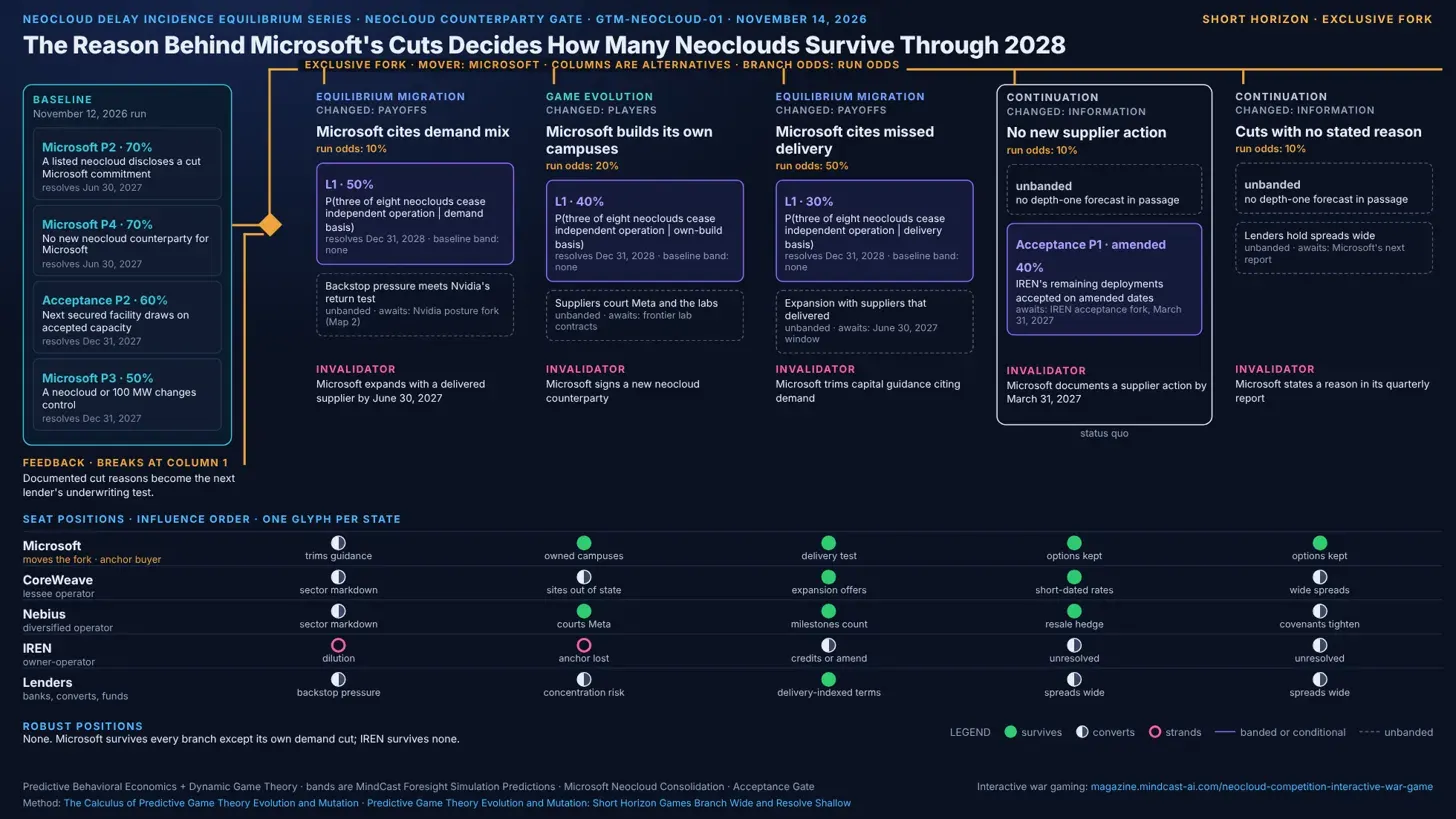
Documented cause is the exception. IREN recorded that Microsoft's design changes drove part of its delay, and no penalty has followed. IREN's grace periods run into early 2027, so Childress remains the series' cleanest open test of whether documentation alone moves the cost.
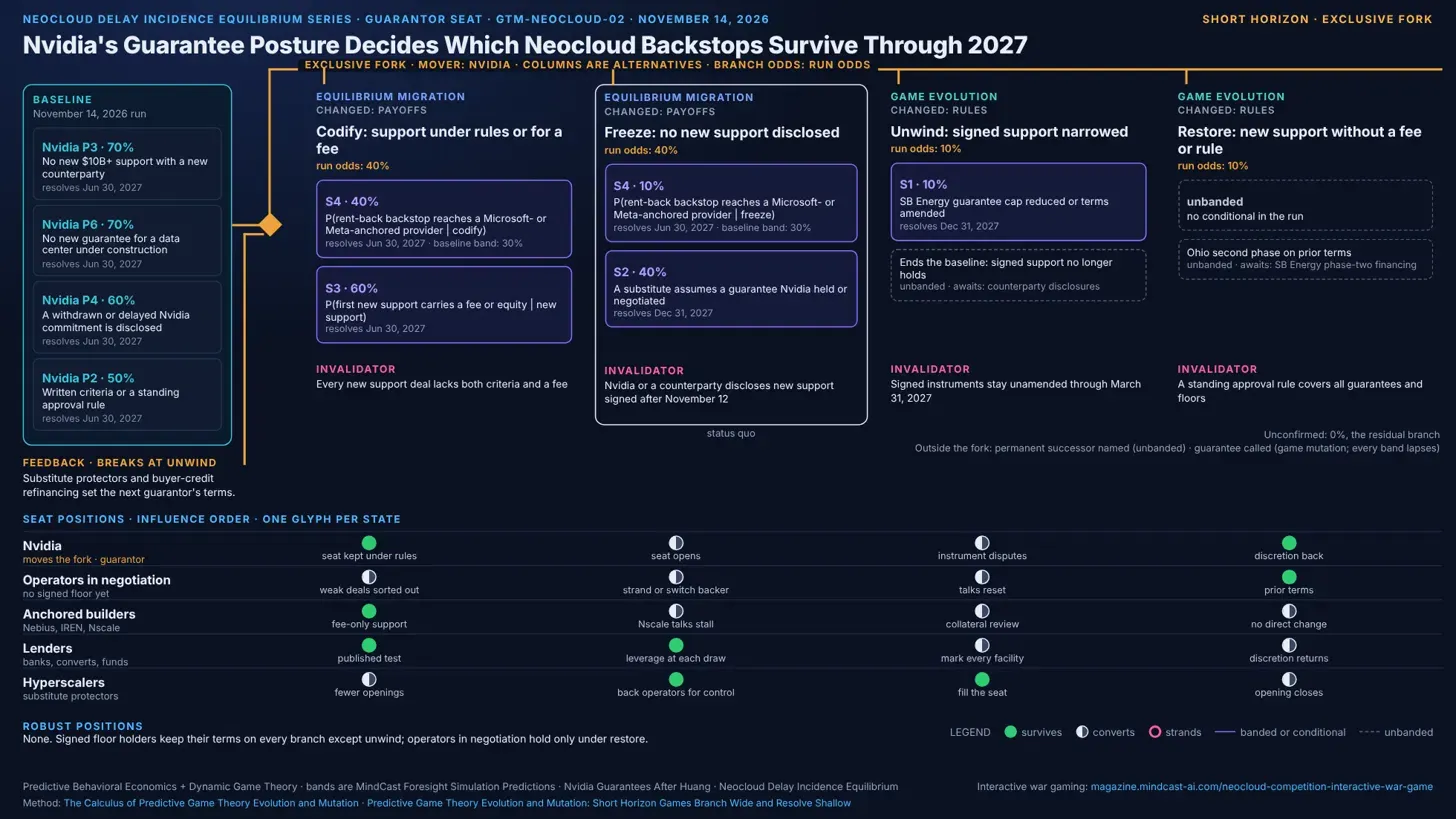
Protection takes three forms: contract repair, a change of ownership or insurance. Nebius secured prepayments covering 50–60% of related capital spending. Google backstopped $3.2 billion of Fluidstack's lease obligations and bought Crusoe's Wyoming site after approvals cleared. Nvidia sold capacity floors, leases and site guarantees to operators without a hyperscaler anchor, much of it justified by the chip sales it unlocked.
Nvidia's guarantor seat changed hands on November 11, 2026. The board accepted Jensen Huang's resignation and named finance chief Colette Kress interim chief executive. Kress had questioned how the guarantees were valued, and a narrower program sends operators toward the strongest remaining protectors. Those protectors are the same hyperscalers that impose delay cost as buyers.
The capacity ladder locates the uninsured risk. Megawatts climb from contracted through authorized, energized and accepted to utilized. The buyer controls acceptance while the operator carries its delay, and no third party insures that step. Only buyer prepayments and documented cause protect an operator there.
The full publication carries what the summary cannot. Three competing explanations each name a falsifier, and six propositions trace delay from its origin to the cost of moving it, each with a breaking condition. A delay control map assigns a controller, a default carrier and an available repair to each of the five capacity rungs. The series holds 28 MindCast Foresight Simulation Predictions with odds from 10% to 70%: four series-level calls in the introduction and 24 across the three case papers, all closing by December 31, 2027. Strategy and risk tables by seat, eight watch signals with named sources and four dated events complete the paper.
Read the full analysis, including the delay control map and all 28 forecasts: https://www.mindcast-ai.com/p/neo-cloud-equilibrium-intro
Lead MindCast Foresight Simulation Predictions:
U1 | At least two new senior secured facilities from CoreWeave, Nebius, IREN or Applied Digital name a hyperscaler or AI-lab contract as primary security, and none names Nvidia support, by December 31, 2027. 70%
U2 | The first substitute guarantee of a neocloud lease, offtake or loan carries capacity rights, equity or another control term by December 31, 2027. 60%, conditional on a substitute instrument
U3 | A neocloud's own buyer becomes its protector through credit support, capital or a site purchase by December 31, 2027. 60%
U4 | A second listed neocloud discloses cause-based delay terms or deemed acceptance by December 31, 2027. 50%
Microsoft P1a | Microsoft's roster cuts rest on delivery and specification by March 31, 2027. 50%
Acceptance Gate P1b | Microsoft accepts at least one remaining IREN deployment on amended terms without credits or termination by March 31, 2027. 40%
Nvidia P1 | Nvidia's guarantee posture by March 31, 2027 resolves to codify at 40% or freeze at 40%.
Every forecast carries a deadline, a falsifier, an activation rule and a public verification source. The seven above lead a series set of 28.
📊 Lenders and Private Credit. Neocloud facilities reset terms at each draw, and buyer credit is replacing vendor support as the security (U1). Risk mitigation: key drawdowns to accepted megawatts and count only signed guarantees.
💼 Unanchored Neocloud Executives. No new Nvidia support through March is the default path, and substitute protectors will ask for control (U2). Risk mitigation: convert negotiated support into signed terms or a dated decline, and negotiate capacity rights before coverage.
💼 Owner-Operators Serving Hyperscalers. Documented buyer cause is the only reliable route for moving delay cost off the operator. Risk mitigation: record every buyer-requested change order before grace periods expire.
⚖️ Counsel. Cause attribution, grace periods and prepayment crediting decide who pays for a slip. Risk mitigation: define cause, evidence and notice before the first slip, and mirror buyer remedies in every lease.
💼 Hyperscalers. Backing a supplier's lease buys capacity rights (U3). Risk mitigation: take control through ownership or offtake priority, since approval rights over a supplier's customers drew the antitrust objection that paused Nvidia's program.
📊 Investors. Contract backlog overstates an operator's position. Risk mitigation: value each operator on its walk-away position, its accepted megawatts and the terms of whoever protects it.
🛡 Insurers. No product covers the step between energized and accepted capacity, the widest gap between who controls delay and who pays for it. Risk mitigation: tie any acceptance-delay cover to the strength of the insured's cause documentation.
🏛 State Utility Commissions. Large-load credit support rests on whoever stands behind the operator, not the operator alone. Risk mitigation: read buyer and guarantor credit, and state what happens when a guarantor narrows its program.
Loughton and Childress now read as two moves under one rule. Nscale held no documented claim against Microsoft and carried the full cost, while IREN documented Microsoft's role and carries none to date. Operators that document cause early and close on buyer credit before the protector changes its terms will hold their sites through the next cycle.
MindCast AI applies Behavioral Economics + Dynamic Predictive Game Theory through MindCast AI Proprietary Cognitive Digital Twin Foresight Simulations (MP CDT FS) and interactive war gaming. The series supports a diagnostic engagement on one contract, financing or credit support decision due before March 31, 2027. Each engagement builds Cognitive Digital Twins (CDTs) of the client's buyers, guarantors and lenders. Contact: [email protected]. War gaming library: www.mindcast-ai-simulation.com/live-fire-intelligence
Related Works
Publication: MCAI Economics Vision: Who Pays for AI Data Center Delays — Series Introduction — https://www.mindcast-ai.com/p/neo-cloud-equilibrium-intro
Atlas: 50-State Authorization Price Atlas — https://magazine.mindcast-ai.com/ai-dc-authorization-50-state-atlas
Model Code: Model Data Center Authorization Code — https://magazine.mindcast-ai.com/model-dc-authorization-code
Case paper: Microsoft Neocloud Consolidation: Energized Megawatts, Not Contract Backlog, Decide Which Neoclouds Survive — https://www.mindcast-ai.com/p/msft-neocloud-consolidation
Case paper: Neocloud Operators and the Acceptance Gate: Accepted Megawatts, Not Signed Backlog, Decide What a Delay Costs — https://www.mindcast-ai.com/p/neocloud-operators-acceptance-gate
Case paper: Nvidia Guarantees After Huang: Underwritten Terms, Not Founder Conviction, Decide Which AI Data Center Credit Holds — https://www.mindcast-ai.com/p/nvidia-neo-cloud-impact
Interactive war gaming: Neocloud Competition Simulation — https://magazine.mindcast-ai.com/neocloud-competition-interactive-war-game
Foundational: AI Data Center Credit Risk, Permitting, Curtailment, and the Cost of Capital — https://www.mindcast-ai.com/p/dc-regulatory-economics-investors
Foundational: AI Data Center Authorization Bargaining Power — https://www.mindcast-ai.com/p/data-center-authorization-bargaining-power
Share Your High-Stakes Matter
Contact Us
Office location
Bellevue, Washington, 98006Send us an email
[email protected]